Minimising manual verification in water and wastewater modelling
Verification remains one of the most time‑intensive and capacity‑constraining stages of hydraulic and wastewater modelling. It is a necessary step in determining spill predictions, supporting investment decisions and providing the evidence required for assurance and audit. Yet for many modelling teams, the way verification is delivered remains heavily manual, repetitive, and resource intensive.
As model complexity, data volumes and expectations increase, manual verification workflows struggle to scale. Experienced modellers spend large portions of their time repeating time-consuming checks rather than analysing behaviour, diagnosing issues or guiding engineering decisions.
This article focuses on how optimisation-led auto-calibration workflows (delivered through advanced modelling and optimisation systems) can solve these challenges by reducing the manual burden of verification and improving traceability and consistency.
Why manual verification has become a bottleneck
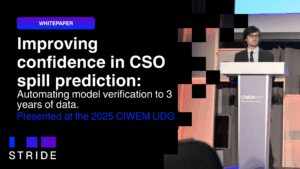
Verification standards have risen sharply in recent years. For CSO spill performance in particular, models are now expected to represent long‑term system behaviour rather than isolated events. This typically involves multi‑year simulations aligned to EDM records, often using depth‑only data from permanent monitors. These simulations generate large volumes of output that are difficult to review comprehensively by hand.
Traditional verification approaches rely heavily on sequential, manual calibration. Parameters are adjusted one monitor at a time, changes are assessed through repeated runs, and interactions across the wider catchment are managed through modeller experience and judgement. Even for a single catchment, this process can take weeks or months. When applied across multiple catchments it becomes a major constraint on delivery.
The burden falls most heavily on senior modellers. Their time is consumed by reviewing and approving straightforward parameter changes, leaving less capacity for diagnosing structural issues or advising planners and decision‑makers. At programme scale, this creates a delivery risk where verification is essential but fails to scale linearly with available resources.
Shifting the focus from manual verification to auto‑calibration
Across many organisations, there is growing interest in reducing the amount of hands-on effort required to reach a fit-for-purpose model. The emphasis is increasingly on auto-calibration, which reflects a desire to accelerate the calibration work that directly supports verification whilst preserving engineering oversight. Auto-calibration supports verification by:
- Accelerating the calibration stage that sits beneath formal verification, shortening the route to a stable and defensible model.
- Shifting repetitive trial-and-adjust activity away from manual execution and into controlled, computational workflows.
- Allowing modellers to focus on defining constraints, reviewing diagnostics, and assessing whether results are hydraulically and operationally plausible.
In optimisation-led systems, calibration is treated as a search problem instead of a sequential task. These systems:
- Explore parameter and monitor combinations together, calibrating the system as a whole against long-term data rather than tuning individual locations in isolation.
- Account for interactions between flow monitors across the wider catchment, reducing unintended knock-on effects.
- Operate within boundaries and limits set by engineers, ensuring changes remain physically realistic and aligned with accepted practice.
In practice, this approach resolves a large proportion of calibration issues early in the process. highlighting where acceptable performance is reached and where normal parameter bounds are insufficient. These latter cases are then isolated for expert judgement, with further parameters introduced in a second run only where necessary to resolve genuine structural or data-driven issues.
The benefits of auto-calibration for wastewater modelling
When implemented in an engineer-led process, auto-calibration delivers clear, practical benefits for modelling teams. These are most visible in how verification effort, assurance and engineering time are managed in everyday work.
Reduced manual effort without loss of control
Auto-calibration removes much of the repetitive, work from verification workflows. Calibration logic and parameter limits are defined by engineers and applied consistently through governed processes, with every run logged automatically. This reduces hands-on effort while maintaining transparency, control and confidence in the results.
Stronger auditability at programme scale
Standardised, repeatable calibration workflows improve consistency across catchments and teams. Inputs and outputs are recorded in a structured way, reducing variation between engineers and simplifying internal review and regulatory assurance, particularly where models are updated or revisited frequently.
More time for engineering interpretation
By handling the volume of calibration and checking computationally, auto-calibration frees experienced modellers to focus on higher-value work. This includes diagnosing network behaviour, assessing sensitivity, and supporting optioneering and planning decisions where professional judgement has the greatest impact with confidence.
Delivering verified models with less manual overhead
The pressures on modelling teams during AMP‑8 are well understood. Verification remains essential, but the way it is delivered needs to reflect the scale and pace of current programmes. Optimisation‑led auto‑calibration provides a practical means of reducing repetitive effort while strengthening consistency and auditability.
Platforms that combine optimisation, automation and wider catchment considerations enable modelling teams to embed these workflows alongside existing tools and practices. The result is faster progression to fit‑for‑purpose models, clearer assurance for planners and regulators, and better use of scarce engineering expertise.
For organisations seeking to maintain technical standards while increasing delivery capacity, minimising manual verification is a necessary step. Auto‑calibration offers a controlled, auditable and engineer‑led way to achieve it.