Using simulation and optimisation to target Sustainable Drainage Systems (SuDS) and reduce CSO spills

Simulation and optimisation can help water companies identify where Sustainable Urban Drainage Systems (SuDS) will deliver the greatest reduction in runoff entering combined sewer networks. By testing different locations SuDS combinations across a catchment, modelling teams can prioritise interventions that reduce pressure on Combined Sewer Overflows while protecting flood performance, controlling cost and supporting long-term planning.
How can SuDS reduce CSO spills?
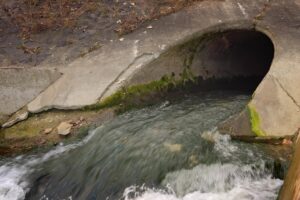
During rainfall, surface water entering a combined system competes for capacity with foul flows. Once the available storage and conveyance capacity is exceeded, a storm overflow may operate. Measures such as rain gardens, permeable paving, detention basins, swales and surface water disconnections can reduce or delay that inflow.
Their effect depends heavily on local conditions. The same intervention may perform differently according to:
- The area and type of surface it serves
- Soil and infiltration characteristics
- Rainfall response
- Available storage and discharge rates
- Its position within the catchment
- Downstream network constraints
Why is SuDS prioritisation difficult?
Traditional modelling methods commonly assess a limited number of candidate sites selected through engineering judgement, land availability or previous studies. This can identify workable schemes, but it provides limited evidence about whether investment has been directed towards the areas with the greatest influence on CSO performance.
The challenge increases when several CSOs, flooding locations and planning horizons are considered together. Removing runoff upstream of one overflow may produce a strong local benefit, while the same investment in another part of the catchment may protect several assets. Some sites may deliver little measurable change because a downstream restriction or another source of inflow controls performance.
Sensitivity analysis can establish which areas of surface water removal have the greatest influence on defined outcomes before detailed designs are developed.
What can simulation tell us?
Going beyond conventional scenario testing. Hydraulic models allow engineers to test how proposed SuDS measures could affect runoff, network performance and CSO operation. Optimisation builds on this capability by enabling many more potential SuDS locations, combinations and design parameters to be explored systematically against defined performance and cost objectives.
Rather than relying on a modeller to select and test individual options in sequence, optimisation uses the hydraulic model to search across a much wider solution space. Each potential solution can be assessed against measures such as:
- Spill frequency – how often a targeted CSO is predicted to operate
- Spill duration – how long overflow operation continues
- Spill volume – how much flow is discharged
- Peak flow – the effect on network loading during critical periods
- Flood risk – whether an intervention affects wider service performance
- Storage recovery – whether assets drain down within acceptable times
- Cost – the estimated investment associated with each solution
This makes it possible to understand not only whether SuDS could improve performance, but where interventions are likely to have the greatest impact, how different measures work together and where further investment begins to deliver diminishing returns.
The quality of that assessment still depends on the underlying hydraulic model. Optimisation does not compensate for a model that poorly represents runoff response, infiltration or the hydraulic arrangements around an overflow. Instead, it makes greater use of a fit-for-purpose model by allowing a much broader range of potential solutions to be investigated consistently.
How does systems optimisation improve SuDS design?
Systems optimisation searches combinations of SuDS locations and sizes against clearly defined objectives and constraints.
Engineers first establish which interventions are feasible, what outcomes matter and which conditions must be maintained. An optimisation algorithm then updates the models and runs the simulation to concentrate testing on promising parts of the design space. Efficient search is important because long-duration hydraulic simulations can be computationally expensive. This approach can answer practical design questions:
- Which subcatchments should be prioritised for surface water removal?
- How much intervention is needed to achieve a defined spill reduction?
- Which combination provides the strongest performance for the available budget?
- Which SuDS locations remain valuable under growth and climate scenarios?
- Where does further investment begin to produce diminishing returns?
Should SuDS be assessed separately from other interventions?
SuDS should be assessed alongside the wider range of feasible catchment interventions.
Surface water removal may reduce flows sufficiently in some areas. Elsewhere, the strongest strategy may combine SuDS with storage, flow controls, real-time control, pipe upgrades or a strategic diversion. An optimisation study can compare green, grey and operational measures within the same set of objectives and constraints.
This wider view also helps identify dependencies. A storage asset may become smaller when upstream runoff is reduced. A pipe upgrade may become unnecessary when several targeted SuDS measures work together. In another catchment, SuDS alone may be unable to overcome a major hydraulic restriction.
These findings support earlier decisions about where detailed surveys, land assessments and design effort should be focused.
How can robust SuDS options be identified?
Robust SuDS options perform consistently across several simulations, planning assumptions and high-performing designs.
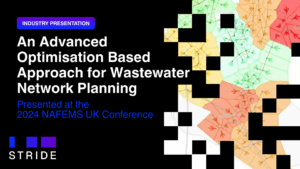
Heatmaps can show which runoff areas have the greatest influence on CSO performance, helping to identify where surface water removal could deliver the greatest benefit. Sensitivity analysis can be added before optimisation using the same underlying workflow, providing greater understanding of how individual runoff areas influence CSO performance before potential SuDS strategies are explored. It can identify when a runoff area becomes sensitive, whether it remains influential as other interventions are introduced, and where interactions exist between interventions.
These results can be visualised through heatmaps, making it easier to identify patterns across the catchment and providing additional evidence to help focus and inform the subsequent optimisation.
These outputs help quantify how individual interventions contribute to flood or spill reduction and whether that contribution represents a cost-effective investment. The benefits can be assessed at a single location, across a group of locations or at catchment level, providing a clearer picture of where SuDS interventions can have the greatest impact.
Turning SuDS modelling into investment evidence
Effective SuDS planning starts with a clear engineering problem, a reliable hydraulic model and a catchment-wide view of performance. Simulation establishes how each intervention affects the network, while systems optimisation identifies where surface water management can deliver the strongest contribution to CSO reduction.
STRIDE uses HEEDS and its Water API to connect hydraulic simulation tools with optimisation, GIS data, cost information and supporting analysis. The resulting workflow can assess SuDS locations and intervention combinations systematically while engineers retain control of feasibility, assumptions and technical review.
This gives water companies a stronger basis for prioritising SuDS investment, comparing it with other measures and selecting schemes that support measurable, auditable CSO improvements.
Learn how to implement SuDS systems and reduce CSO spills in every catchment. Download A Water Modeller’s Guide to Reducing CSO Spills now.